


Public Art Auction
LOT 054
MUNAKATA Shiko
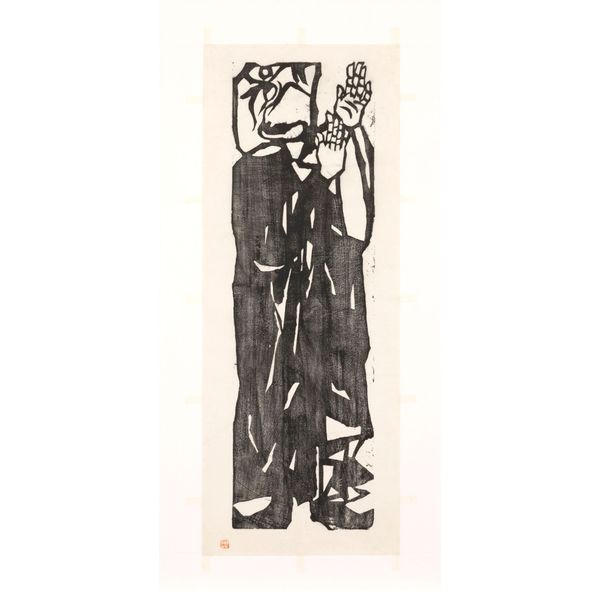
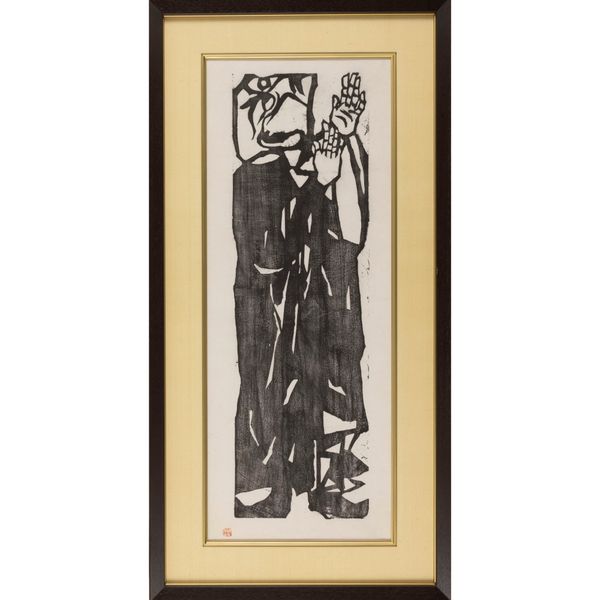
UPĀLI, FROM “THE TEN GREAT DISCIPLES OF SHAKYAMUNI”
| Technique | woodcut |
| Signature | stamped on the lower left |
| Frame | framed |
| Size | sheet size : 102.3×39.5 cm image size : 94.5×30.3 cm |
| Year of the work | 1939 |
| Certificate | certificate of authenticity by Shiko Munakata Authentication Committee |
| Literature | “The Complete Works of Shikō Munakata, Vol. 2: Fences of the Gods (I),” Kodansha, 1980, no. 73 & p. 187, no. 75 |
HIGHLIGHT
Munakata Shiko’s Shaka Jūdaideshi (The Ten Great Disciples of Buddha) is a representative series of woodblock prints created in 1939 (Shōwa 14). It is a monumental work that established his international reputation, having been awarded the Grand Prize for Printmaking at the 1956 Venice Biennale. The series depicts twelve figures—comprising the bodhisattvas Manjushri and Samantabhadra, along with the Ten Great Disciples of Buddha—rendered in a powerful black-and-white contrast in a screen format.
However, due to war damage, the woodblocks for Manjushri and Samantabhadra were lost and later re-carved in 1948 (Shōwa 23), resulting in a final configuration of fourteen panels.
The Ten Great Disciples refer to the ten principal disciples of the Buddha, each distinguished by a particular virtue: Śāriputra (wisdom), Maudgalyāyana (supernatural powers), Ānanda (hearing the teachings), and others, each fulfilling a specific role.
The present work depicting Pūrṇa represents the “foremost in preaching,” symbolizing fervor and dynamism in propagation of the Buddhist teachings. The composition is charged with violently swirling lines, expressing a powerful outward-moving energy.
Upāli, regarded as “foremost in observing the precepts,” is the disciple who most strictly upheld monastic discipline. The work conveys a quiet yet unwavering inner strength. Although the two figures embody contrasting qualities, both demonstrate the breadth of Munakata’s expressive spirituality.
The original version of Samantabhadra Bodhisattva shows him with hands joined, gazing toward the disciples on his right. The carving is vigorous, with strong ink bleeding, retaining the tension and spontaneity of the creative process.
In the re-carved version, his hands point toward heaven and earth while his face looks upward into the void. The composition is more structured and clarified, reflecting Munakata’s own reinterpretation and resulting in a highly refined work.
Regarding the creation of this series, Munakata wrote in The Way of Woodblock Prints (1957, Shōwa 31) as follows:
“At that time, at the Tokyo National Museum, I saw Subhūti from Hōryū-ji and decided to depict the Ten Great Disciples. (Previously, I used cherry wood blocks, which were difficult to carve but took ink well and were preferred by me.) This time, I found suitable paulownia wood, so I decided not to waste the material. (omitted) The top of the block corresponded to the head, and the bottom to the soles of the feet. The width was fully used for robes and arms. I wanted to make full use of the power of the wood itself, so I devised a method to let the forms emerge naturally.”
He further states—often retold as legend—that:
“When I worked, I simply carved ten disciples of Buddha in human form… I drew directly onto the block without preparatory sketches… After completion, it was said that having only ten disciples was insufficient for a folding screen, so I added two bodhisattvas: Samantabhadra on the left and Manjushri on the right. In this arrangement, the ten disciples are divided left and right, aligning with Buddhist philosophy, balancing light and shadow in ways I could not have planned. On good days, I could complete three panels in one day. It was like animalistic strength. The entire series was completed in one week. When I showed it to Yanagi (Sōetsu), he applauded and patted my shoulder with joy. I was so overwhelmed that I could hardly comprehend my own happiness.”
This account reveals his state of creative abandon and astonishment at unexpected outcomes.
Munakata Shiko was an artist who, without reliance on preparatory sketches, unleashed years of accumulated discipline and spiritual intuition directly into his work. Among his oeuvre, Shaka Jūdaideshi stands out as an exceptionally pure expression, created in a near state of unconscious spontaneity.
The work demonstrates a direct connection between inner impulse and the inherent force of the woodblock itself, achieving a level of intensity and completeness that surpasses many of his other works. It represents the pinnacle of Munakata’s improvisational creative power and stands as one of the defining masterpieces of his artistic career.
CONDITION REPORT
SEE OTHER WORKS
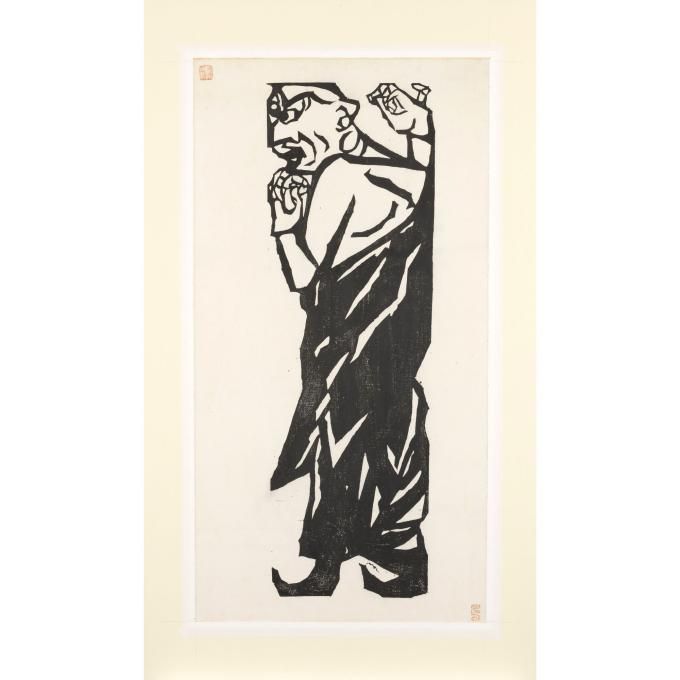 LOT 055MUNAKATA Shiko
PŪRA, FROM “THE TEN GREAT DISCIPLES OF SHAKYAMUNI”
JPY 1,800,000 - 2,800,000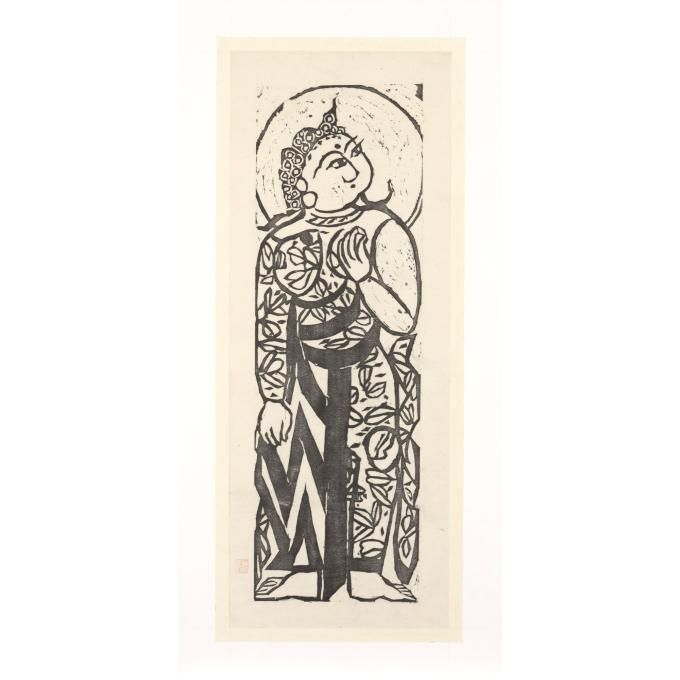 LOT 056MUNAKATA Shiko
SAMANTABHADRA (RECUT PLATE), FROM “THE TEN GREAT DISCIPLES OF SHAKYAMUNI”
JPY 2,000,000 - 3,000,000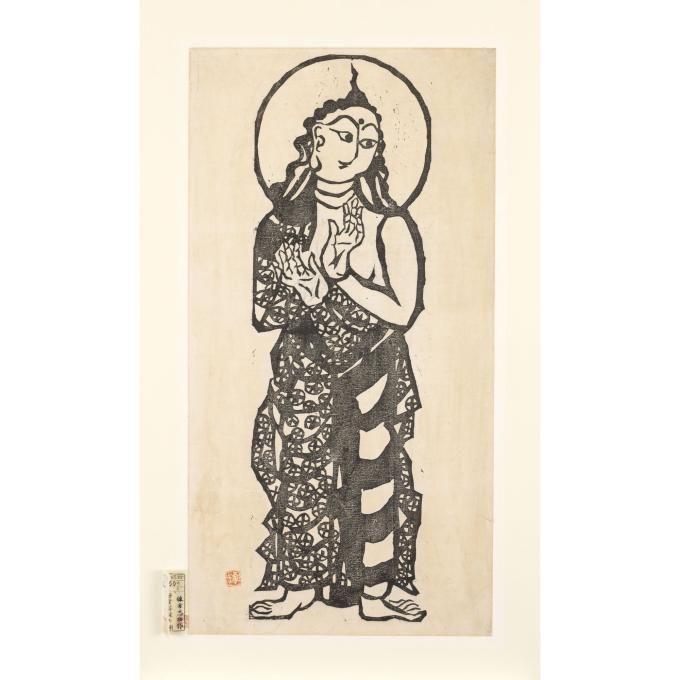 LOT 057MUNAKATA Shiko
SAMANTABHADRA, FROM “THE TEN GREAT DISCIPLES OF SHAKYAMUNI”
JPY 3,500,000 - 5,500,000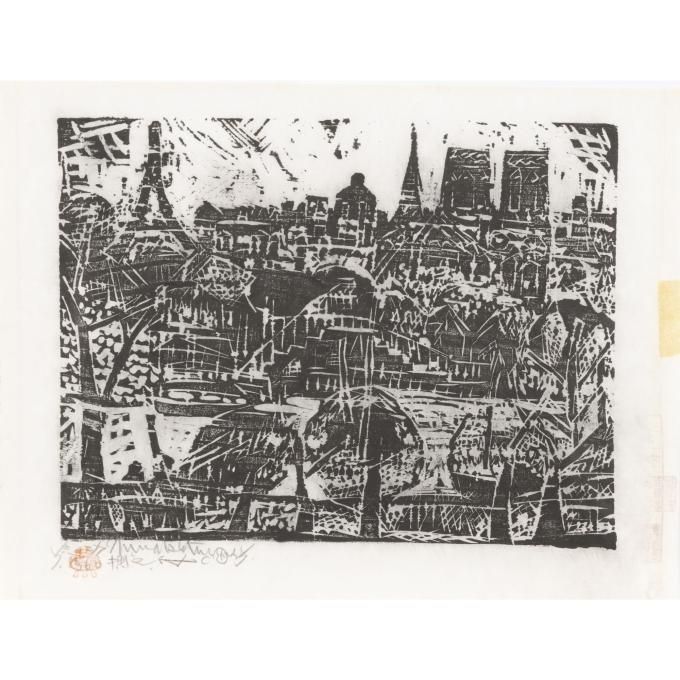 LOT 061MUNAKATA Shiko
PARIS LANDSCAPE
JPY 200,000 - 300,000