


Public Art Auction
LOT 043
Ossip ZADKINE
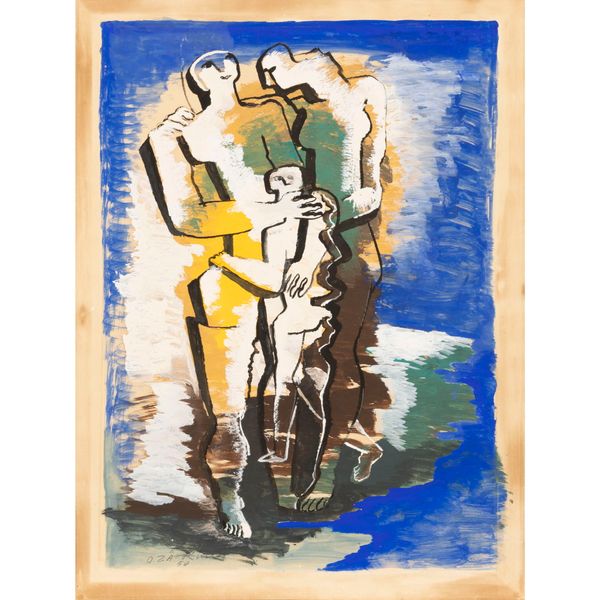
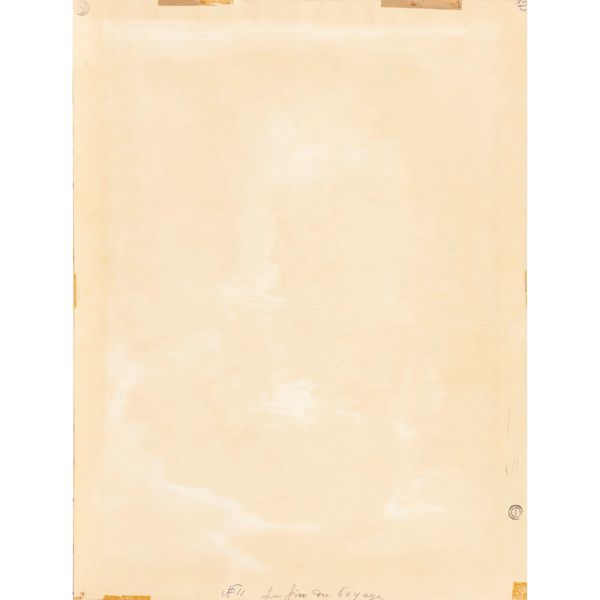
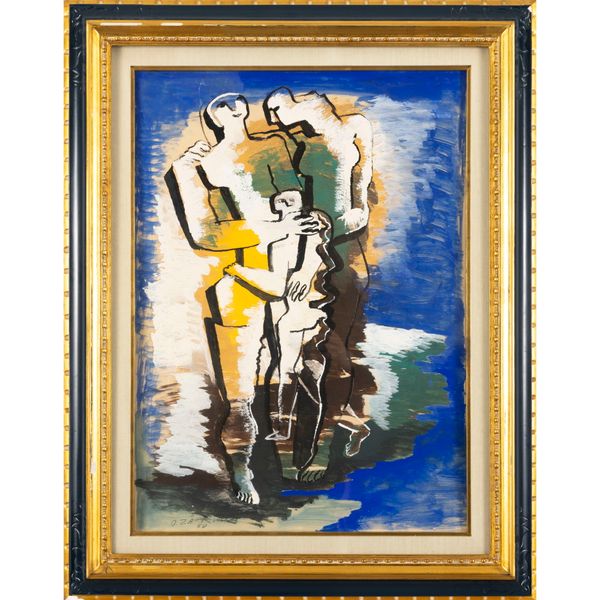
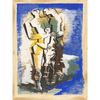
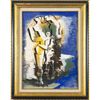
LA FIN DU VOYAGE (THE END OF THE JOURNEY)
| Technique | gouache on paper |
| Signature | signed and dated on the lower left |
| Frame | framed |
| Size | 64.9×48.7 cm |
| Year of the work | 1950 |
| Certificate | certificate of authenticity by Zadkin Research Center |
| PROVENANCE | Private collection, Japan |
HIGHLIGHT
Ossip Zadkine studied at the Regent Street Polytechnic in 1905 and later moved to Paris in 1910. His experience in Paris played a decisive role in his artistic formation. Within the stimulating environment of the post-Impressionist movements and the avant-garde circle of artists such as Pablo Picasso and Amedeo Modigliani, he acquired a sense of freedom and boldness in his creative practice. He was also influenced by ancient Egyptian sculpture and primitivism, which led him to establish a unique sculptural language based on geometric construction and direct carving. His works are installed in public spaces around the world and are held in major institutions such as the Musée Zadkine (the former studio converted into a museum), the Royal Museum of Fine Arts Antwerp, and the Centre Pompidou. His geometric and powerful forms, which translate Cubist principles into sculpture, are internationally recognized as significant achievements in 20th-century sculpture. In Japan as well, through his connections with the Nika Association, he established ties with the Japanese art world, and his works are now held in museums across the country, including the Yamanashi Prefectural Museum of Art.
Although this work is a two-dimensional piece, the overlapping planes and shifts in form strongly reveal a sculptural sensibility, as if the composition were being modeled in volume, allowing one to perceive the essence of Zadkine’s lifelong pursuit of sculptural expression. Multiple figures are closely arranged at the center of the composition, suggesting interrelated relationships through Cubist fragmentation and reconstruction of form. Their proximity and arrangement evoke a sense of intimacy and psychological connection. Color and form interact with one another; color permeates beyond contours, reconstructing physical overlaps as visual layers and blurring the boundaries of individual entities. The sharply defined, powerful outlines recall his identity as a sculptor, while the dense color fields and the contrast between blue and yellow bring a gentle vitality to the composition.
Created around 1950, this work belongs to the period when Zadkine established his international reputation, including winning the Grand Prix at the 25th Venice Biennale. During this time, alongside sculpture, his gouaches and lithographs also gained increasing recognition, expanding the scope of his artistic expression. The striking blue tones seen in approximately 765 gouaches and drawings are among the defining characteristics of these works on paper and have maintained stable appreciation in the market.
This work was created in the same year as his celebrated sculpture The Three Graces, now in the collection of the Yamanashi Prefectural Museum of Art. Despite the difference in medium, both works share a common formal logic in their compositional arrangement of figures and their treatment of volumetric mass. A comparison of the two reveals that, during this period, Zadkine conceived of the human figure not as an isolated entity, but as a relational structure in which forms interact and interpenetrate one another.
CONDITION REPORT